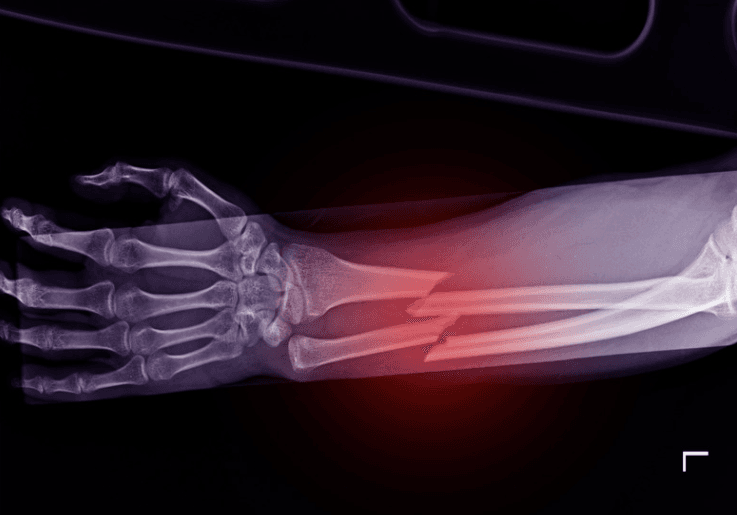
Did You Know? A DEXA Scan Can Help Predict the Odds of a Bone Fracture
January 8, 2025
Did you know that according to the US Centers for Disease Control & Prevention (CDC), DEXA scans can detect weak or brittle bones to help predict the odds of a future fracture? That’s right, DEXA scans are considered the gold standard for determining if your bone density is improving, worsening, or staying the same.
When you get a DEXA scan with Nomad Fit Lab, you’ll immediately receive a report that provides comprehensive insights into your bone mineral density (BMD). BMD is a direct indicator of bone strength.
A lower BMD is associated with a higher risk of bone fractures and can lead to conditions like osteoporosis, significantly increasing fracture risk. A higher BMD is associated with denser bones, meaning they are less likely to break due to trauma or falls.
T-Scores and Z-Scores
Your BMD is determined using T-scores and Z-scores. Basically, we are comparing healthy young adults (your T-score) and age-matched adults (your Z-score). To achieve your T-score, your BMD result is compared with the results from healthy 25- to 35-year-old adults of your same sex and ethnicity. The standard deviation (SD) is the difference between your BMD and that of healthy young adults. Positive T-scores indicate the bone is stronger than normal; negative T-scores indicate the bone is weaker than normal.
According to the World Health Organization, osteoporosis is defined based on the following bone density levels:
- A T-score within 1 SD (+1 or -1) of the young adult mean indicates normal bone density.
- A T-score of 1 to 2.5 SD below the young adult mean (-1 to -2.5 SD) indicates low bone mass.
- A T-score of 2.5 SD or more below the young adult mean (more than -2.5 SD) indicates the presence of osteoporosis.
Calculating Bone Fracture Odds
The risk for bone fracture doubles with every SD below normal. A person with a BMD of 1 SD below normal (T-score of -1) has twice the risk of bone fracture as a person with a normal BMD. When this information is known, people with a high risk for bone fracture can be treated with the goal of preventing future fractures.
To achieve your Z-score your BMD is compared to an age-matched norm. This is called your Z-score. Z-scores are calculated in the same way, but the comparisons are made to someone of your age, sex, race, height, and weight.
Knowing BMD can help you and your healthcare provider come up with plans to improve your bone strength and prevent worsening conditions.
To determine your BMD schedule a DEXA scan with Nomad Fit lab today: https://www.nomadfitlab.com/locations
More Posts
Subscribe to Our Newsletter
Sarah VanKirk